

Repairing Failed Foundation Crack Repairs
in Haverhill, MA
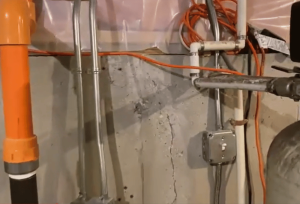
This Haverhill home’s concrete foundation had multiple cracks, including one that had already been repaired years earlier with epoxy injection. Water eventually found its way back through the repaired area, so Done Right Services removed and prepared the problem areas and sealed them using our liquid rubber foundation welding method.
In the video below, Jeremy from Done Right Services walks through the failed previous repair, explains how foundation welding differs from injection, and shows how the cracks were prepared and sealed from inside the basement.
Schedule an Inspection Give Us a Call
The Problem: A Previously Repaired Crack Was Leaking Again
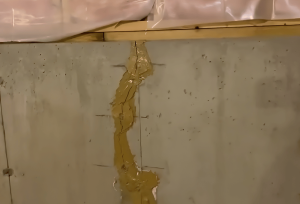
One of the cracks in this Haverhill basement had already been repaired under the builder’s warranty using an epoxy injection system. The original repair was roughly 10 years old and still had the injection ports visible along the wall.
Epoxy had been pumped into the crack through a series of drilled ports. Over time, movement in the concrete allowed the repaired area to open again and water returned.
The homeowner also had additional foundation cracks in the basement, so our team addressed several problem areas during the same project.
- Location: Haverhill, MA
- Foundation type: Poured concrete
- Problem: Non-structural foundation cracks allowing water into the basement
- Previous repair: Epoxy injection with drilled injection ports
- Work performed: Crack grinding and preparation, liquid rubber foundation welding and waterproof sealing
- Repair location: Interior basement walls
- Warranty: Lifetime foundation warranty and 15-year money-back guarantee as described by Done Right Services
Why the Old Epoxy Repair Did Not Last
Epoxy injection works by placing material directly inside the crack. On this project, the earlier contractor drilled a series of holes into the foundation and injected epoxy between the two sides of the crack.
Jeremy explains that concrete foundations still experience small amounts of normal movement. When that happens, an injected repair can lose its bond along one side of the concrete and create a new path for water beside the original repair.
The goal on this project was not simply to inject the same crack again. Instead, Done Right Services used a wider surface repair that overlaps the crack and allows the repaired area to accommodate minor foundation movement.
Our Foundation Crack Repair Process
The cracks were first exposed and ground clean so the repair material could bond directly to the concrete instead of sitting over dirt, old coatings or failed repair material.
What We Did
- Prepared the cracks: The concrete was ground clean around each crack to expose a solid repair surface.
- Removed problem material: Previously repaired areas were prepared so the new system was not simply being placed over an old failed repair.
- Heated the concrete: Jeremy describes using heat to open the pores of the concrete before applying the repair material.
- Applied liquid rubber: The waterproof repair material was worked across the crack rather than injected only into the opening.
- Created a wider weld: A narrow crack is covered by a substantially wider repair area to allow for normal minor movement.
- Extended the repair at the bottom: The repair was carried outward near the floor and footing to help prevent water from finding another path into the basement.
Foundation Welding vs. Foundation Injection
Done Right Services refers to this repair method as foundation welding because the waterproof material is applied across the prepared concrete instead of being injected only into the crack.
Jeremy explains that the concrete is heated during preparation so the liquid rubber can work into the surface. The finished repair then overlaps both sides of the crack, creating a wider waterproof barrier over the problem area.
- Injection places epoxy or urethane inside the crack
- Foundation welding covers and overlaps the crack from the interior surface
- The concrete is ground and prepared before the repair material is applied
- The finished weld is wider than the original crack
- The system is intended for non-structural leaking foundation cracks
Why the Repair Extends Across the Bottom of the Wall
The finished repair does not stop exactly where the visible crack meets the basement floor. Done Right Services extends the waterproofing approximately a foot in each direction along the bottom of the wall.
Jeremy explains that water moving down behind the foundation wall can reach the footing and look for another path back into the basement. Extending the repair outward creates additional resistance around the bottom of the crack rather than leaving a vulnerable endpoint directly above the footing.
This creates the upside-down T shape seen in the finished repair.
Why We Repair Foundation Cracks from Inside
For the non-structural leaking cracks shown in this project, Done Right Services performs the repair from inside the basement rather than excavating around the exterior foundation.
Exterior excavation can mean removing soil, landscaping, driveways or other finished areas just to reach the crack. Existing exterior waterproofing materials can also make it difficult to properly prepare the concrete surface.
Interior access allows the crack itself to be exposed, ground clean and sealed without tearing apart the property outside. Even in a finished basement, Jeremy explains that drywall can usually be opened around the crack and patched after the waterproofing work is complete.
The Finished Repairs
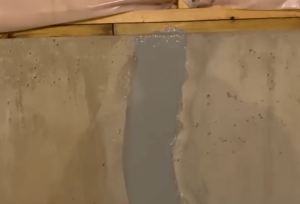
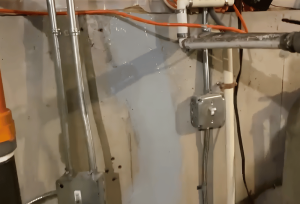
After grinding, preparation and sealing, the foundation cracks were covered by clean, continuous waterproof repairs rather than another series of injection ports.
- Previously repaired crack resealed: The leaking crack with the old injection repair received the new foundation welding system.
- Additional crack repaired: A second crack was prepared and sealed during the same project.
- Wider waterproof coverage: Each repair extends beyond the narrow crack itself.
- Bottom of the repair protected: The material extends outward near the floor to reduce another potential water path.
- Interior repair: The work was completed without exterior excavation.
When a Foundation Crack May Be More Than a Waterproofing Problem
The crack repairs shown in this project are for non-structural concrete foundation cracks such as hairline and shrinkage cracks that are allowing water into the basement.
Jeremy notes that significantly wider cracks or a foundation showing substantial movement should be evaluated for structural concerns before waterproofing work begins. Foundation crack waterproofing is designed to stop water intrusion, not correct major structural movement.
Have More Than One Foundation Crack?
Multiple foundation cracks can often be repaired during the same visit. The condition, width and repair history of each crack can be evaluated together so the project can be approached as a whole rather than treating each problem separately over time.
Done Right Services provides foundation crack repair for leaking non-structural concrete foundation cracks throughout Massachusetts and Southern New Hampshire.
Foundation Crack Repair FAQ
Can a previously repaired foundation crack start leaking again?
What is foundation welding?
Do foundation cracks have to be repaired from outside?
Are foundation crack repairs structural repairs?
Why does the repair extend along the bottom of the wall?
Is foundation crack repair warrantied?
Is a Foundation Crack Letting Water Into Your Basement?
If you have a leaking concrete foundation crack, even one that has already been repaired before, Done Right Services can inspect the area and determine the right next step.
Schedule an inspection today or call 978-808-7873.