

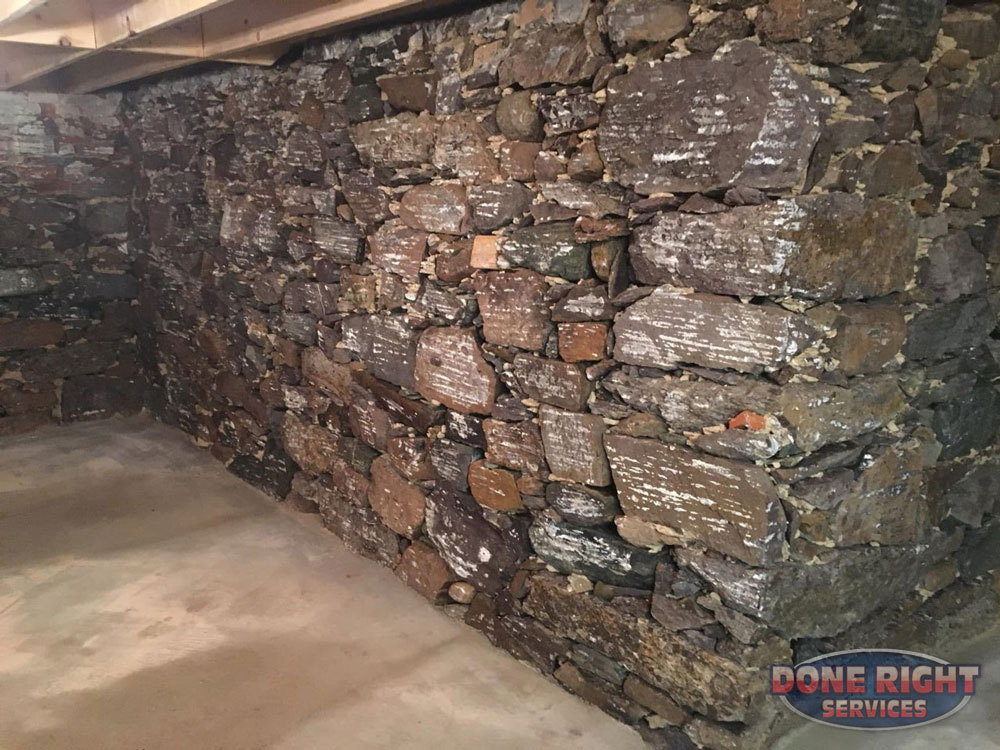
Stone foundations are common beneath older homes throughout Worcester, especially in neighborhoods developed long before poured concrete foundations became standard. When mortar starts crumbling, stones loosen, or moisture appears along basement walls, homeowners often assume fixing the problem means digging up the entire outside of the house.
In many cases, it does not.
Quick answer: A stone foundation can often be repaired without exterior excavation when the main problems involve deteriorated mortar joints, isolated loose stones, minor gaps, or moisture entering through repairable sections of the wall. Interior repointing and targeted masonry repairs may restore stability without disturbing landscaping or excavating around the home. More serious movement, substantial wall displacement, drainage problems, or structural failure may require exterior access or additional stabilization.
What local homeowners should know
-
Interior repointing can address deteriorated mortar joints without excavating around the entire foundation.
-
Older homes in neighborhoods such as Elm Park, Crown Hill, and Massachusetts Avenue may have stone or fieldstone foundation construction that requires repair methods suited to historic masonry.
-
Worcester’s seasonal freezing and thawing can place additional stress on masonry where moisture has entered cracks and mortar joints.
-
Loose stones, bulging walls, persistent water entry, and significant cracking should be evaluated before choosing a repair method.
-
Avoid simply coating a deteriorated stone wall with waterproof paint because it may hide symptoms without correcting failing mortar or underlying moisture problems.
Why Can Some Stone Foundations Be Repaired Without Excavation?
Some stone foundations can be repaired without excavation because deterioration often begins in the mortar joints rather than requiring complete reconstruction of the wall. When the stones remain reasonably stable and the damage is accessible from the basement, deteriorated material can often be removed and replaced from the interior while preserving the existing masonry.
This approach is particularly relevant in Worcester because the city has a substantial inventory of older housing. The City of Worcester describes much of its multifamily housing stock as more than 100 years old, and municipal historic-district records document numerous residential buildings dating to the 1800s and early 1900s.
Fieldstone foundations can vary significantly from one property to another. Some have wide mortar joints and irregular stones. Others have been repaired multiple times with different materials. An inspection helps determine whether an interior masonry repair is appropriate or whether movement outside the wall must also be addressed.
Done Right Services helps local homeowners evaluate foundation conditions and determine which areas may need masonry repair. After that first assessment, we can focus on the condition of the existing foundation rather than automatically assuming extensive excavation is necessary.
What Local Conditions Affect Stone Foundations?
Local conditions affect stone foundations primarily through moisture, temperature changes, aging masonry, and soil conditions around the home. In Central Massachusetts, water entering deteriorated joints can become especially problematic as temperatures fluctuate through the freezing season, making drainage and sound mortar important parts of protecting older foundation walls.
A geotechnical report prepared for a Worcester property discusses seasonal freeze and thaw conditions and recommended approximately four feet of frost protection for that particular project, illustrating why frost is a real design consideration in the area. The exact conditions beneath an existing home can vary by site.
Older properties around Elm Park, Crown Hill, Montvale, and Hammond Heights can also have foundations built under very different construction practices than modern homes. City historic-preservation materials document residential development across these areas beginning in the 1800s and continuing into the early 1900s.
That combination of age, moisture exposure, and seasonal weather makes the condition of the mortar just as important as the condition of the stones themselves.
What Are the Warning Signs That a Stone Foundation Needs Repair?
A stone foundation may need repair when mortar is falling out, stones are becoming loose, gaps are widening, water is entering the basement, or portions of the wall appear to be moving. These symptoms should be evaluated individually because cosmetic mortar deterioration and structural movement require very different responses.
Watch for:
-
Mortar that crumbles when lightly touched
-
Pieces of mortar collecting along the basement floor
-
Visible gaps between stones
-
Individual stones that appear loose or displaced
-
Damp spots or water entering through mortar joints
-
A wall that appears bowed, bulged, or noticeably out of alignment
-
Cracks that are widening or changing over time
-
Repeated repairs that continue to break apart
White mineral deposits on masonry can also indicate that moisture has been passing through the wall. The deposits themselves do not necessarily mean the foundation is structurally failing, but they are a reason to investigate where the moisture is coming from.
When Does a Stone Foundation Need Exterior Excavation?
Exterior excavation may be necessary when the problem cannot be safely or effectively corrected from inside the basement, particularly when significant wall movement, exterior drainage defects, failed sections of masonry, or conditions behind the wall need to be accessed. Excavation is a repair tool, not an automatic requirement for every aging stone foundation.
For example, a homeowner may have deteriorated interior mortar while the wall itself remains stable. Repointing may be sufficient in that situation.
A different home may have soil pressing against a displaced wall or substantial water collecting against the exterior foundation. Repairing only the interior surface would not address the source of that problem.
We look at the wall as a system. The condition of the stones, mortar, surrounding grade, drainage, water entry, and visible movement all matter before a repair approach is selected.
What Commonly Causes Stone Foundation Problems in Worcester?
The most common contributors to stone foundation deterioration in Worcester include aging mortar, repeated moisture exposure, freeze-thaw cycles, poor drainage, and changes made to an older foundation over many decades. These conditions frequently overlap, which is why identifying the cause is more useful than simply covering the visible damage.
Aging mortar: Mortar naturally deteriorates over time. Some local houses have foundations that have been exposed to generations of seasonal moisture and temperature changes.
Water around the foundation: Gutters, downspouts, grading, and surface drainage can affect how much water reaches basement walls.
Freeze and thaw conditions: Moisture within openings and deteriorated masonry can contribute to continuing damage during cold-weather cycles.
Incompatible previous repairs: Very hard repair materials applied to older masonry may behave differently from the original wall. The repair material should be appropriate for the existing stone and mortar conditions.
Building age: Worcester’s historic districts and older residential neighborhoods contain buildings representing more than a century of construction practices. A repair method suitable for modern concrete should not automatically be applied to old fieldstone masonry.
How Can Homeowners Help Prevent Further Foundation Deterioration?
Homeowners can help prevent additional deterioration by controlling exterior water, monitoring mortar joints, keeping roof drainage away from the foundation, and addressing small masonry problems before substantial sections become loose. These simple checks are especially useful during spring snowmelt, periods of heavy rain, and before another Central Massachusetts winter.
Walk around your property several times a year and look at where water travels.
Keep gutters operating properly and make sure downspouts discharge where water can move away from the foundation. Check for low areas next to the house where rainwater collects.
Inside the basement, periodically inspect the same sections of wall. Comparing conditions over time can help distinguish an old, stable imperfection from an active problem.
Homeowners can safely monitor visible mortar and moisture. Loose masonry, pronounced bulging, substantial displacement, or suspected structural movement should be professionally evaluated rather than treated as a DIY patch.
What Results Can You Expect From Interior Stone Foundation Repair?
Interior stone foundation repair can restore deteriorated mortar joints, secure appropriate loose areas, close unwanted openings, and improve the overall condition of a serviceable masonry wall. The realistic result depends on how much deterioration exists and whether exterior water, soil pressure, or structural movement is contributing to the problem.
Repointing is not the same thing as painting over the wall. Proper masonry work addresses deteriorated joint material and restores the spaces between individual stones.
Homeowners should also understand that an old stone foundation does not normally become visually identical to a new poured-concrete wall. Its irregular appearance is part of its construction. The goal is a sound, appropriately repaired masonry assembly, not necessarily a perfectly flat surface.
What Mistakes Should Worcester Homeowners Avoid?
Worcester homeowners should avoid treating every stone foundation problem as a waterproofing problem because visible moisture, missing mortar, and wall movement can have different causes. A repair that conceals the symptoms without correcting the deteriorated masonry or exterior water source may make future evaluation more difficult.
Mistake: Covering loose mortar with paint or coating.
Consequence: Deterioration remains behind the finished surface.
Better approach: Evaluate and repair damaged joints first.
Mistake: Filling only the most obvious hole.
Consequence: Nearby deteriorated joints may continue shedding mortar.
Better approach: Inspect the surrounding section of wall.
Mistake: Ignoring roof drainage.
Consequence: Water may continue reaching the foundation after masonry repairs.
Better approach: Correct gutter, downspout, and grading concerns where appropriate.
Mistake: Assuming excavation is always necessary.
Consequence: A homeowner may plan for considerably more disruption than the actual condition requires.
Better approach: Have the foundation evaluated before choosing a repair method.
What Is a Common Local Stone Foundation Scenario?
A common local scenario is an older Worcester County home where the basement foundation remains generally aligned, but sections of mortar have become sandy or are falling onto the basement floor. The homeowner may also notice damp joints following periods of rain while the stones themselves appear largely stable.
That situation does not automatically mean the entire exterior foundation needs to be exposed.
A professional can assess the deteriorated areas, check for visible movement, examine moisture patterns, and determine whether interior repointing or another targeted repair is appropriate.
The situation changes if the same wall is significantly bulging, stones are actively moving, or exterior drainage is continually directing water against the foundation. Those conditions may require a broader repair strategy.
What Services Can Address Deteriorating Stone Foundations?
Stone foundation problems may be addressed through masonry repointing, targeted stone repair, gap repair, moisture-source evaluation, and other foundation work selected according to the wall’s actual condition. The right solution starts with determining whether deterioration is limited to accessible masonry or connected to movement, drainage, or exterior conditions.
We can examine the affected areas and explain which type of repair makes sense for the foundation that is actually in front of us.
How Does Interior Repair Compare With Exterior Excavation?
Interior repair is generally best suited to accessible mortar deterioration and localized masonry problems, while excavation becomes more relevant when the source of the problem lies outside the wall or exterior access is required. Neither method is automatically better because each addresses a different set of foundation conditions.
Interior work may also reduce disturbance to patios, walkways, landscaping, porches, or narrow spaces between neighboring homes.
Exterior access, however, can be necessary when drainage improvements, exterior wall work, or more extensive reconstruction must occur from outside.
For homes on tighter lots or in established neighborhoods, including areas near Elm Park and Crown Hill, avoiding unnecessary excavation can be valuable. The key word is unnecessary. A repair should be chosen because it addresses the underlying condition, not simply because it is less disruptive.
Where Do We Help Homeowners With Stone Foundation Concerns?
We help homeowners in Worcester and surrounding Central Massachusetts communities understand their stone foundation repair options. Properties in nearby communities such as Auburn, Holden, Shrewsbury, and Millbury may have similar older masonry construction, although every foundation should be assessed according to its own age, drainage, site conditions, and previous repairs.
Older homes throughout Worcester County can differ dramatically even when they were built during the same period.
What Can Happen If Foundation Deterioration Is Ignored?
Ignoring foundation deterioration can allow missing mortar, loose masonry, and moisture problems to become more extensive, potentially turning a manageable repair area into a larger project. Waiting is particularly unhelpful when water repeatedly enters the same joints or visible movement is progressing from one season to the next.
Not every imperfect stone foundation requires immediate major work. Older masonry naturally has irregular surfaces, previous repairs, and cosmetic variations.
The signs worth acting on are changes such as continuing mortar loss, growing openings, recurring water entry, displaced stones, and measurable wall movement.
FAQ
Can a Stone Foundation Really Be Repaired From Inside?
Yes, many stone foundation repairs can be completed from inside when deterioration is concentrated in accessible mortar joints and the wall remains sufficiently stable. Interior repointing can replace failed mortar without excavating the entire exterior. Significant displacement, exterior water problems, or structural concerns may require a different approach.
Are Stone Foundations Common in Older Worcester Homes?
Yes, stone and fieldstone foundations can be found beneath older Worcester homes, particularly properties dating from periods when masonry foundation construction was common. City historic records document numerous residential buildings from the 1800s and early 1900s, including examples with fieldstone foundations in historic neighborhoods.
Does Worcester’s Winter Weather Damage Stone Foundations?
Winter conditions can contribute to deterioration when moisture reaches vulnerable masonry and is repeatedly subjected to freezing and thawing. Healthy masonry does not automatically fail because temperatures fall below freezing, but deteriorated joints and ongoing water exposure deserve attention before another cold season.
Does Crumbling Mortar Mean My Foundation Is Failing?
No, crumbling mortar does not automatically mean the entire foundation is failing. Mortar can deteriorate while much of the stone wall remains stable. The important questions are whether stones are moving, whether the wall is bulging, how extensive the deterioration is, and whether water or soil pressure is contributing.
Can I Repoint My Worcester Stone Foundation Myself?
Small cosmetic maintenance may be manageable for some homeowners, but substantial repointing is better evaluated professionally because old masonry requires compatible materials and proper joint preparation. Stop DIY work if you find loose stones, noticeable wall movement, widespread deterioration, substantial water entry, or uncertainty about whether the wall is structurally stable.
Will Repointing Stop Water From Entering My Basement?
Repointing can reduce water pathways through deteriorated mortar joints, but it cannot correct every source of basement water. If runoff, grading, downspouts, groundwater conditions, or exterior defects are contributing to the problem, those conditions may also need attention. Moisture control works best when both masonry condition and water sources are evaluated.
Do Historic Worcester Homes Require Special Foundation Repair Methods?
Older masonry should be repaired with methods appropriate to its existing stone, mortar, and construction rather than automatically treated like modern concrete. Worcester’s preservation materials document residential construction extending back well into the 19th century, so homeowners in historic areas may be dealing with very different masonry than newer properties.
How Do I Know Whether Excavation Is Necessary?
Excavation is usually determined by what is causing the foundation problem and where the needed repair must be performed. If deterioration can be appropriately corrected from inside and no exterior condition requires access, excavation may be avoidable. Significant displacement, drainage work, or exterior reconstruction may make digging necessary.
Protect Your Worcester Stone Foundation With the Right Repair Approach
An aging stone foundation does not automatically mean a major excavation project is ahead. The condition of the mortar, stability of the stones, moisture patterns, drainage, and visible movement all help determine how extensive the repair actually needs to be.
Find the Right Repair for Your Worcester Home
We focus on identifying what your existing foundation needs so you can make an informed decision without assuming more work is necessary than the condition requires.